AI SEARCH · MEASUREMENT GUIDE
How to Rank in Google AI Mode: Read the Measurement, Not the Percentage
Use the measurement check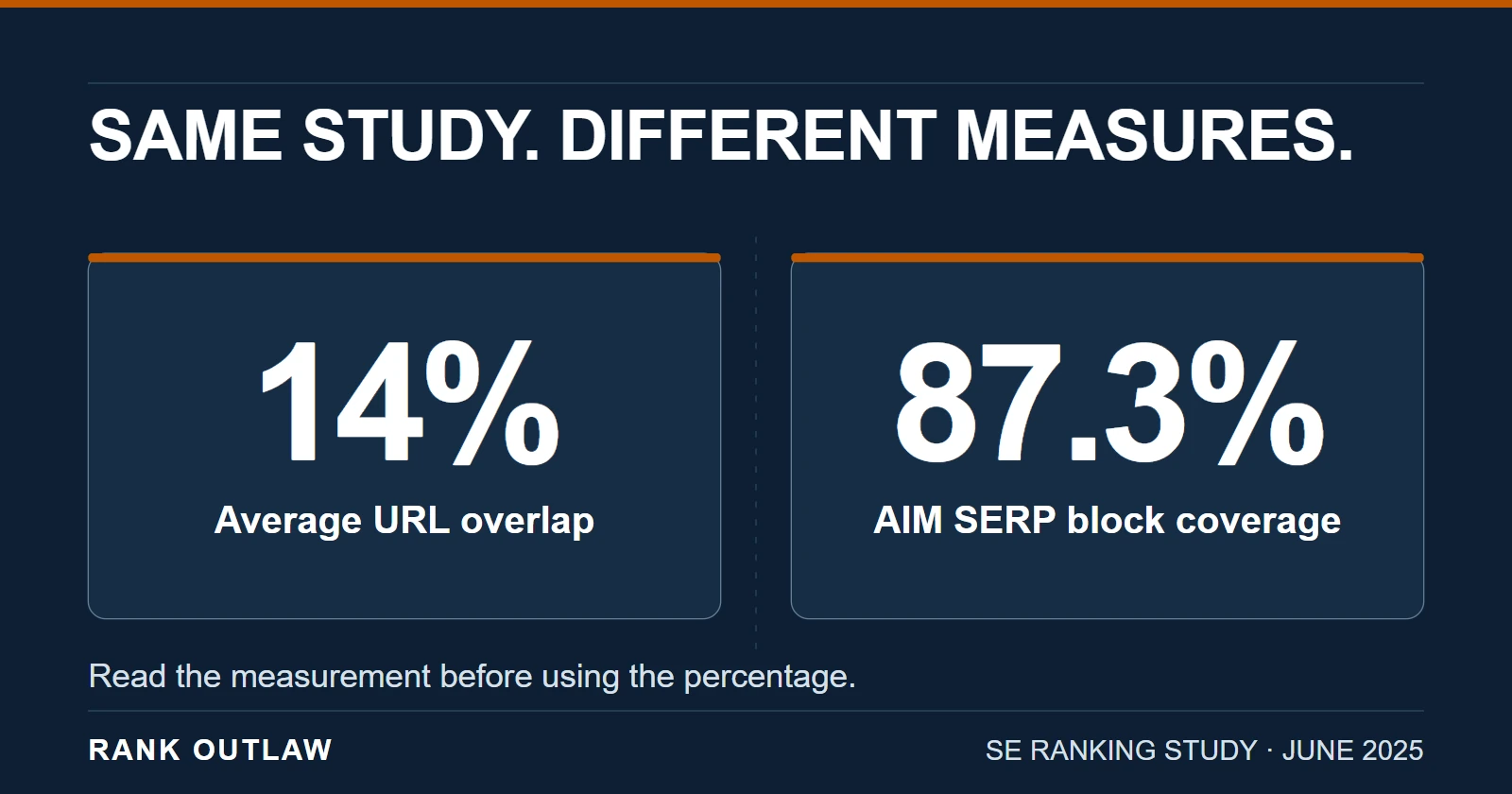
Learning how to rank in Google AI Mode starts with understanding the surface: Google’s deeper conversational search experience, reachable directly or from an AI Overview follow-up. You ask a long question, get a generated answer with citations, and keep questioning it.
Search for how to rank in Google AI Mode and you’ll find checklists quoting citation statistics with confidence. One quotes 14% URL overlap with Google’s organic top 10. Another quotes 87% coverage for links in an organic-style block inside AI Mode. SE Ranking’s study of 10,000 US keywords reports both.
Neither is wrong. They count different things.
Rank Outlaw’s Zero Page SEO™ workflow defines what each page answers and connects related pages. Below, we show how reviewing this article changed a claim. No citation outcome was measured.
Before acting on a statistic, check what was counted, which search surface was measured, and when the data was collected.
What is Google AI Mode? (and how it’s different from AI Overviews)
AI Overviews appear automatically above standard results when Google decides a summary helps, with the regular results continuing below. AI Mode is the deeper conversational surface.
They are no longer separate destinations. In its May 2026 Search announcement, Google described a connected AI Search experience: you can ask a follow-up from an AI Overview and move straight into AI Mode, with the context of your original question carried forward. Google has said that experience is live globally.
Google’s own documentation says both features may use a query fan-out technique, issuing multiple related searches across subtopics and data sources. The same page says AI Mode and AI Overviews may use different models and techniques, so the responses and links they show will vary. Treat them as related systems, not one system in two skins.
AI Mode can also show organic-style results. SE Ranking named one such block the AIM SERP. It was rare in the June 2025 sample; its links are a distinct population in the study.
For the related surface, see our guide to how to rank in AI Overviews.
How ranking signals differ in AI Mode
The 14% and the 87% are both true
SE Ranking analyzed 10,000 US keywords in June 2025. Two of its findings get quoted interchangeably, and shouldn’t be.
The 14% figure is the average exact-URL overlap between AI Mode’s sources and Google’s organic top 10, across 9,721 keywords. Domain overlap was 21.9%. Against the top 20, URL overlap fell to 12%.
The 87.3% figure measures a different population. It’s the coverage rate of links inside AIM SERP blocks, the organic-looking results section appearing in some AI Mode answers. That block accounted for 310 of 122,617 links, or 0.3%, appearing in 79 of 9,734 responses.
The 14% is the study’s average overlap measurement across its analyzed keywords. The cited page does not specify that overlap formula’s denominator, so do not read it as the share of all AI Mode citations drawn from the top 10. The 87.3% describes coverage within a narrow link category. One is not a correction of the other.
This pattern repeats everywhere
BrightEdge’s 16-month study covers May 2024–September 2025. At the September endpoint, roughly 16.7% of AI Overview citations came from the top 10; 54.5% overlapped with any organic ranking. One counts page one; the other counts a wider ranking range.
Ahrefs reported 76.1% in July 2025, examining the three most visible AI Overview citations. Its March 2026 update found 37.9% of captured URLs within the first 10 SERP blocks, or 37.1% in the standard organic top 10. Improved parsing captured a broader citation set in 2026. The changed population prevents reading this as a clean decline.
Semrush’s July 2025 study found AI Mode at roughly 54% domain and 35% URL overlap with the top 10, against AI Overviews at roughly 86% domain and 67% URL. Different surfaces, different answers, one study.
Before comparing percentages, verify the surface, unit, ranking range, citation type, sample, date, denominator and capture method. Comparable observations can describe a trend; they cannot establish its cause.
What the evidence does establish
The cited studies show that organic results and AI citations overlap without being equivalent. They do not establish how much moving a particular page up the rankings would change its chance of citation. Pages outside the original query’s top 10 can also be cited.
Volatility is the finding nobody leads with
SE Ranking ran the same keyword set three times on the same day. Average exact-URL overlap across all three runs was 9.2%. Compared in pairs it rose to roughly 18.5%. Responses averaged 12.6 links.
Same question, same day, and most cited sources changed.
Use repeated observations to describe the citation sets you actually see. A single captured answer is a weak basis for deciding which page to rebuild.
On the age of these numbers
The organic-overlap dataset used here dates to June 2025, collected in the US on non-logged-in accounts. Newer research shows other parts of the citation mix changed materially by February 2026. Read every percentage here as a dated observation, not a rule.
Before choosing an edit, apply the six-field measurement check.
How to rank in Google AI Mode: where to start
Start by checking whether the page is indexed and eligible for a search snippet. Then address a specific unanswered reader question, make the answer understandable in context, and measure observations consistently. These are practical next steps; the cited studies do not supply a formula for winning citations.
Google’s documentation states that to be eligible as a supporting link in AI Overviews or AI Mode, a page must be indexed and eligible to be shown in Google Search with a snippet. There are no additional technical requirements.
In May 2026 Google published a guide to optimizing for generative AI search. It emphasizes unique, valuable content and firsthand experience. Generative AI features still use core Search ranking and quality systems.
Google does not require llms.txt, an AI-facing rewrite, content chunking, or special schema for AI features. Standard structured data remains relevant to the Search features it supports.
So the labels below are deliberate: Google-documented, observed, or our own judgment.
Publish non-commodity content. Google-documented. Firsthand experience, specific figures, a real point of view. Google’s guide puts unique, non-commodity content near the center of its guidance.
Cover relevant sub-questions. Rank Outlaw inference. SE Ranking recommends broader topical coverage, but its study did not test whether adding breadth causes more citations. Address distinct reader needs; avoid duplicate pages and the maintenance burden they create.
Front-load each section. Rank Outlaw heuristic. Make the opening answer understandable on its own so readers can follow and quote it accurately. Google does not require content chunking.
Keep answers self-contained. Rank Outlaw heuristic. Avoid “as covered above.” Repeat the anchor noun instead of a pronoun. Editorial practice, not a ranking requirement.
Maintain standard structured data and consistent naming. Google guidance plus editorial judgment. Google requires no special AI schema. Our preference for explicit entity names is editorial practice, not a demonstrated citation advantage.
Show accurate dates, matched by correct datePublished and dateModified. Rank Outlaw heuristic.
Our architecture-first sequence is a workflow recommendation, not an outcome tested by these studies. See how to optimize for AI search for its wider application.
The local finding, and why it moved
In SE Ranking’s June 2025 dataset, google.com was the most-cited domain in AI Mode at 5.7% of all citations. Of those google.com links, 97.9% pointed to Google Business Profiles, and none pointed to traditional organic results.
In February 2026, across 68,313 keywords and 1.32 million citations, google.com accounted for 17.42% of all citations. The destination mix differed: 36.1% of Google citations pointed to Business Profiles. 59% pointed to Google’s own organic search results, shown in the right-hand panel of the AI Mode answer.
These are observations eight months apart with substantially different keyword samples. They do not isolate a change in Google’s behavior or show that Business Profile optimization became less effective.
Google Business Profiles appeared as AI Mode citation destinations in the February sample. Keep hours, photos, and business information accurate as part of your local SEO groundwork. The study does not quantify the citation benefit of making those updates.
Evidence limit: Rank Outlaw holds no proprietary AI Mode citation dataset. This guide uses Google’s documentation, named third-party studies, and explicitly labeled editorial judgment. Missing methods remain unresolved.
AI Mode vs. AI Overviews vs. featured snippets (comparison table)
AI Overviews generate a summary from sources; featured snippets extract a passage from a page. The table separates the interface from the citation measurements.
Swipe or scroll sideways to read every column.
| Attribute | AI Mode | AI Overviews | Featured snippets |
|---|---|---|---|
| What it is | Deeper conversational surface | Generated summary above results | A passage lifted from one page |
| How you reach it | Opened directly, or from an AI Overview follow-up | Appears automatically | Appears automatically |
| Standard results shown | Usually not, though organic-style blocks appear | Yes, below the box | Yes, it is a result |
| Answer length | Long, multi-part | Usually one to three paragraphs | One paragraph, list, or table |
| Sources per answer | ~12.6 (SE Ranking, Jun 2025) | ~13.3 (SE Ranking, Jun 2025) | One |
| Same-day stability | Low. 9.2% URL match across three runs | Not measured in that study | Not measured in that study |
Overlap with organic rankings, reported separately because these are not comparable measurements:
Swipe or scroll sideways to read every column.
| Surface | Study | What it measured | Result |
|---|---|---|---|
| AI Mode | SE Ranking, Jun 2025 | Exact-URL overlap with top 10 | 14% |
| AI Mode | Semrush, Jul 2025 | URL overlap with top 10 | ~35% |
| AI Overviews | Semrush, Jul 2025 | URL overlap with top 10 | ~67% |
| AI Overviews | Ahrefs, Jul 2025 | Top 3 most visible citations ranking top 10 | 76.1% |
| AI Overviews | Ahrefs, Mar 2026 | Cited URLs in first 10 SERP blocks, after a parsing change | 37.9% |
| AI Overviews | BrightEdge, Sep 2025 endpoint | Citations from top 10 | ~16.7% |
| AI Overviews | BrightEdge, May 2024–Sep 2025 | Citations from any organic position at endpoint | 54.5% |
Our editorial recommendation across these surfaces is to make each answer clear in its own context. That helps readers follow the page and quote it accurately; it is not a documented formula for winning citations.
Frequently asked questions
Is Google AI Mode the same as AI Overviews?
No. AI Overviews appear automatically on the results page; AI Mode is the deeper conversational surface. Since May 2026, an Overview follow-up can carry the original context into AI Mode. Google says the surfaces may use different models and techniques, so their answers and links can differ.
Why do different studies report such different numbers?
They often measure different populations or use different calculations. SE Ranking’s 14% average URL overlap and 87.3% coverage within rare organic-style blocks are not interchangeable. Ahrefs also changed citation capture between its 2025 and 2026 studies. Before comparing figures, verify the surface, unit, ranking range, citation type, sampling design and date, plus the denominator and calculation method. If a method is missing, leave the comparison unresolved.
How do I know if my content shows up in AI Mode?
Use the generative AI performance report in Google Search Console. Google announced the report on June 3, 2026; its current help page records worldwide rollout on August 31, 2026. Two things to understand. It reports impressions, pages, countries, devices, and dates without exposing click metrics, though clicks from AI features do still count in your standard Performance report. And it combines generative features including AI Overviews and AI Mode rather than isolating AI Mode. Anyone claiming Search Console gives an AI-Mode-only view is wrong. Repeated observations of priority queries, collected manually or with a suitable monitoring tool, can show whether your page appears in those sampled answers. Record the query, date, location, account state, and cited URLs. These checks are samples, not a complete AI Mode visibility report.
Does AI Mode use different ranking factors than regular search?
Google has published no separate factor list and describes AI Mode as rooted in core Search ranking and safety systems. What’s observable is different retrieval behavior: a cited source set diverging from organic results more than AI Overviews do, and high run-to-run variation. You’re working the same fundamentals across a wider set of sub-questions.
Will AI Mode replace traditional search results?
Not on current evidence, though click behavior is shifting. Pew tracked 900 US adults across 68,879 Google searches in March 2025 and found users clicked a traditional result on 8% of visits where an AI summary appeared, against 15% where none did. They clicked a link inside the summary on 1% of visits. That study measured AI summaries rather than AI Mode; Pew reconstructed the result pages in April for searches recorded in March. The association does not by itself prove that summaries caused the lower click rate. Track organic traffic alongside sampled AI visibility without treating either as a substitute for leads or revenue.
Use the six-field measurement check
Use this editorial decision aid to choose what to investigate. It is not a prediction model. Open the printable comparison worksheet for a completed 14%/87.3% example and blank fields. Save the worksheet page to keep an offline copy; print it to retain your filled answers.
Record six fields for each percentage: surface, unit, ranking range, citation type, sample, and collection date. For the sample field, record the population and sampling design as well as the sample size. Before any comparison, also verify the denominator, aggregation method, and capture or parser method. Then apply these rules in order:
- A field or calculation method is missing: mark the comparison unresolved. Read the original methods or ask the publisher before using the percentage in a forecast.
- The metric, population, sampling design, or capture method is incompatible: label the figures different measurements. Explain each separately; do not calculate a growth rate or claim one corrects the other. Different sampled records are not automatically incompatible when the underlying design remains comparable.
- Dates or sampled records differ, but definitions and methods are comparable: a descriptive trend may be reasonable. Record sample-size differences and uncertainty; use caution when representativeness is unclear. A trend alone does not identify its cause.
- The comparison passes those checks: describe only the difference supported by the measured population. Matching definitions make comparison more defensible; they do not establish a ranking effect or a business outcome.
Worked example: 14% versus 87.3%
Both figures concern AI Mode, URLs, Google’s top 10, and SE Ranking’s June 2025 collection. The citation type and sample differ. The 14% figure averages overlap across 9,721 keywords; 87.3% concerns 310 links in rare AIM SERP blocks. Decision: different measurements. Keep both labeled. The unpublished overlap denominator is an additional limit. Do not use 87.3% to revise the 14% estimate or claim a change in performance.
For an initial observation log, collect three responses to each of five priority queries. Record location and account state alongside the six fields. Fifteen responses are a small baseline, not a representative market estimate; expand the sample only when the decision warrants it.
Use these decision criteria before editing the page:
- A verified eligibility problem: if Search Console URL Inspection or the page’s indexing/snippet directives show a problem, resolve that issue first. An absent citation alone does not diagnose an indexing problem.
- An eligible page with a specific answer gap: if the page omits a relevant customer question or relies on outdated evidence, improve that answer. Preserve useful scope rather than creating a page for every query variation.
- No verified page defect, but inconsistent observations: log more comparable samples before making structural changes. If collection conditions differ, fix the measurement first.
Recheck after a change with the same collection method. A changed citation set alone does not show that your edit caused it.
A documented decision: correcting this article’s 14% claim
The September draft said, “14% of AI Mode citations come from Google’s organic top 10.” That wording turned an overlap measurement into a share-of-citations claim.
During this article’s internal review, we checked the original SE Ranking study. It reports average URL overlap across 9,721 keywords, but the cited page does not specify the overlap formula’s denominator. We could not substantiate the draft’s interpretation.
Decision: replace the claim with “14% URL overlap” and disclose the missing denominator. Keep 87.3% separately labeled as coverage within AIM SERP blocks. We chose precision over a simpler headline comparison.
Observed result: the copy and comparison guidance changed. We have not measured a resulting change in citations, traffic, or leads. This is a documented editorial correction, not a performance case study. The decision record preserves the original wording and source-file hashes.
PUT THE MEASUREMENT TO WORK
Build a clearer search foundation
Learning how to rank in Google AI Mode starts with eligible pages, useful answers, and honest measurement. Rank Outlaw’s Zero Page SEO approach sequences the work: define the entities, structure and scope the pages, connect them with internal links, then apply standard markup.
That is our recommended foundation for handling changing citation sets. It does not guarantee inclusion. Read about Zero Page SEO to see how we organize that work.
Apply the measurement check