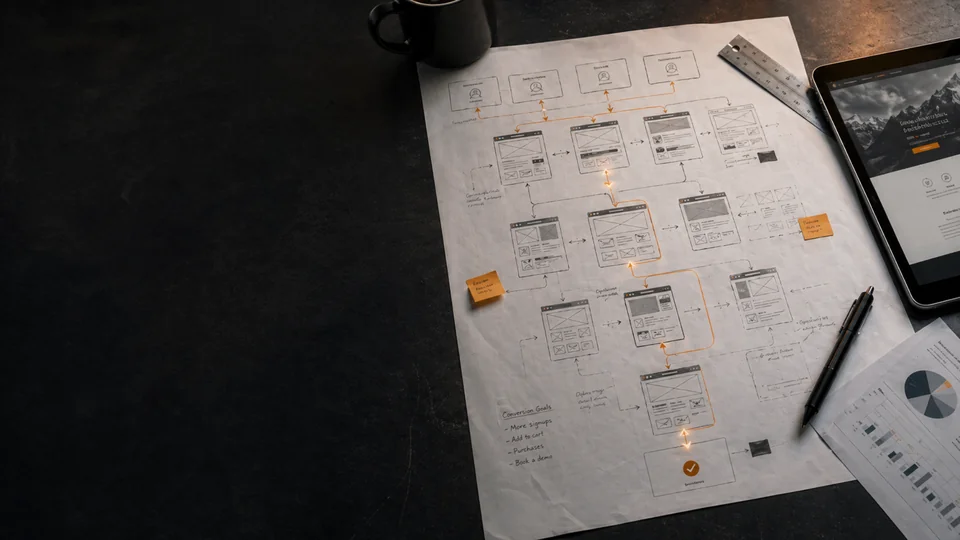
Conversion architecture system showing connected user journey touchpoints and optimization paths

Conversion Rate Optimization Services

Conversion Rate Optimization Services

Most CRO Agencies Start With Tests. Rank Outlaw Starts With Conversion Structure.

Traffic alone does not create pipeline.
The site still has to turn qualified visitors into leads.

Get a Quote
What Are CRO Services?
Direct Answer
Conversion rate optimization services improve how many website visitors become leads, customers, or buyers. Rank Outlaw audits the site's conversion structure first, fixes structural barriers, then applies A/B testing, funnel analysis, landing page optimization, form optimization, and CTA refinement.

What CRO Services Do When the Foundation Is Right

Rank Outlaw's conversion rate optimization services connect to our broader seo services because traffic alone does not create pipeline. The site still has to turn qualified visitors into leads, sales, or buyers.

Most CRO agencies start with tests. We start with conversion structure. The pages most agencies are asked to optimize were never built to convert in the first place — and no amount of A/B testing fixes a foundation that's missing. We pair classic CRO work with the structural fixes that make it work. The result is a site built to convert, not a site that's tested into converting.

Who This Is For

This service is built for businesses where one or more of these is true:

  • You get traffic but not enough leads
  • Your landing pages rank but don't convert
  • Your paid traffic is expensive and underperforming
  • Your site has service pages but no clear conversion path
  • You've worked with a CRO agency before and the lift didn't compound
  • You're an SEO, paid media, or marketing lead and your data shows traffic without pipeline

If any of those describe your site, the conversion problem is probably structural, not tactical. That's the work we do.

Not the right fit if: you want button-color tests without structural work, need a one-time design refresh, or don't have enough traffic or conversion data to measure changes.

Most CRO agencies test pages that were never built to convert.
Rank Outlaw fixes the foundation first, then optimizes from there.

Most CRO Agencies Optimize Pages That Were Never Built to Convert

The standard CRO playbook looks like this: install heatmaps, run session recordings, identify drop-off points, design A/B tests, ship the winners, repeat. It's a real methodology, and when it's applied to a site that's already built well, it works.

The problem is that most sites aren't built well for conversion. They were built for content management, or for design aesthetics, or for whatever the last agency was selling. The information hierarchy confuses visitors. The decision paths are hidden behind navigation logic that made sense to the team building the site but not to the buyer trying to use it. Pages weren't built around a conversion goal in the first place — they were built to exist.

When tactical CRO runs on top of that foundation, you get isolated wins. You move a button, lift conversion 4%, ship the variant, and move on to the next test. Six months later, you have a list of test wins and a conversion rate that hasn't moved much because you've been treating symptoms while the structural problems stay in place.

Durable improvement requires fixing what the tests can't reach. That's where conversion structure comes in.

If your conversion rate isn't moving, the issue probably isn't your buttons. It's the decision path they sit inside.

Request a Conversion Architecture Audit

What Rank Outlaw Does Differently

Rank Outlaw's conversion rate optimization services run in three layers, in this order:

1. Conversion structure audit first. Before any test runs, we evaluate the site's structural foundation — page hierarchy, internal linking, decision paths, navigation logic, and how each page is built to handle the traffic arriving on it.

2. Foundation fixes. We repair the structural issues that prevent conversion from working at all. This is where many sites reveal the issues that have been limiting performance from the start.

3. Then tactical CRO. A/B testing, heatmap analysis, funnel optimization, landing page work, form and CTA refinement — the standard CRO toolkit, but running on a foundation that's built to support it.

This is the order most agencies skip. The result is testing that produces gains that survive future site changes instead of marginal lift, because each win is built on a structural base that doesn't undo itself the next time the site changes.

Typical CRO Agency

  • Starts with tests
  • Optimizes page elements
  • Measures isolated wins
  • Separates traffic from conversion

Rank Outlaw CRO

  • Starts with conversion structure
  • Fixes decision paths
  • Builds improvements that hold over time
  • Connects SEO, AIO, and CRO

The methodology underneath this work is the Apex Ranker System™ — Rank Outlaw's documented production framework for sites built to rank and convert from the foundation up.

How Architecture-Driven CRO Works

The work runs in three stages. The order matters. Most agencies start at Stage 3 because that's the visible, billable work. We start at Stage 1 because that's where the leverage is.

Audit before tests. Foundation before tactics.

1
Audit
2
Foundation
3
Optimize
1
Audit
Site structure review. Decision path analysis. Funnel mapping. We're identifying the structural blockers before we touch a test. This stage produces a diagnosis: what's working, what's broken at the foundation, and what tactical CRO can address once the foundation is sound.
2
Foundation
We fix the structural issues that prevent conversions from working. Restructuring navigation that hides decision paths, rebuilding internal links so high-intent pages get the equity they need, or rewriting page hierarchies so visitors can find what they came for. Foundation work follows our process: diagnosis-first, structural before tactical.
3
Optimize
Once the foundation supports conversion, tactical CRO runs the way it's supposed to. A/B testing produces wins that survive because they're not fighting the structure. Heatmap insights become actionable. Landing pages get optimized against a clear conversion goal instead of a moving target.

What Conversion Architecture Actually Looks Like

Before any test runs, Rank Outlaw maps the structural layer that determines whether tactical CRO will compound or stall. That work is documented, visible, and reviewable — it's the audit deliverable, not a black box.

The mapping covers entry paths from organic search and paid traffic, decision points where visitors choose between continuing or leaving, friction zones in forms and navigation, CTA hierarchy across the page and across the site, trust signal placement relative to the decision moment, and drop-off coordinates pulled from analytics and heatmap data.

The audit produces four deliverables: a funnel map showing how visitors move from entry to conversion goal, a decision-path diagnosis identifying where structure is creating drop-off independent of tactical issues, a prioritized fix list with each item's expected impact on the tactical work that follows, and a testing recommendation for which tests will actually move the number once the foundation supports them.

You see all of it before the foundation work begins. The architecture is the layer that makes the rest of CRO work — and you see exactly what we're going to build before we build it.

The Difference

Most CRO engagements produce a list of test wins and a conversion rate that hasn't moved much. Architecture-first CRO produces gains that survive future site changes because each win is built on a structural base that doesn't undo itself.

What's Included in a Conversion Rate Optimization Engagement

Every engagement is scoped to the site, but a typical engagement includes:

Conversion Structure Audit
Structural review of decision paths, page hierarchy, and navigation logic. The diagnosis that drives every later decision.
Funnel & Behavior Analysis
Mapping the visitor journey, identifying drop-off points, and reading heatmap and session data to separate structural drops from tactical ones.
A/B Testing Program
Test design, implementation, statistical analysis, and roll-out of winning variants. Run on a foundation built to support it.
Landing Page & CTA Optimization
Restructuring landing pages around clear conversion goals, refining forms and CTAs, with content production coordinated where pages do both SEO and conversion duty.
Mobile Conversion Optimization
Mobile sessions convert differently than desktop. Most sites are responsive without being optimized for mobile decision behavior.
Quarterly Performance Reporting
Documented results, test outcomes, and recommendations for the next quarter. Trajectory, not just snapshots.
Not every site needs every deliverable. The engagement is scoped to the work each site needs. We tell you what we'd recommend after the audit, not before.

What We Fix in CRO Foundation Work

A conversion structure audit produces a prioritized list of findings. Every site is different, but these are the patterns that show up most often — and the impact each has on pipeline.

FindingWhat It Looks LikeWhy It Hurts PipelineWhat We Change
Orphaned service pageA high-intent page with weak internal links pointing to itVisitors and search engines struggle to understand which pages matter mostRebuild internal links so high-intent pages get the equity and prominence they need
Weak CTA hierarchyMultiple CTAs competing on the same page with no clear primaryUsers hesitate, default to inaction, and leave without taking the next stepDefine one primary CTA per page, demote secondary actions, and remove competing ones
Trust proof buried too lowTestimonials, reviews, and case study references placed below the decision pointProof arrives after doubt has already formed; the buyer is already goneMove trust signals up next to the decision point so proof arrives before doubt
Mobile form frictionToo many fields, poor tap targets, or required data the visitor isn't ready to giveHigh-intent mobile visitors abandon at the highest-intent momentReduce form fields, fix tap targets, and stage data requests across the funnel instead of all upfront
Message mismatchAd or search intent doesn't match what the landing page actually deliversQualified traffic loses confidence within seconds and bouncesRealign landing page copy with the search or ad intent that brought the visitor
Hidden decision pathsNavigation logic that buries high-intent pages two or three clicks deepBuyers can't find the next step even when they want to take itRebuild navigation around buyer intent so the next step is one click away from where the buyer is

Every audit produces findings specific to the site. The list above is what shows up across most engagements. The fixes — and the order to make them in — come from the diagnosis, not from a checklist.

Zero Page SEO™ and Conversion Optimization

Conversion optimization is the capture layer for Zero Page SEO — Rank Outlaw's methodology for positioning sites in AI-generated search answers.

When a visitor arrives from an AI Overview, Perplexity citation, ChatGPT search result, or another AI-assisted search experience, that visitor came with high intent and a specific expectation. They're not browsing. They came because an AI system pointed them to a source that answered their question. If the page they land on isn't built to handle that intent — if the decision path is unclear, the structure is confusing, or the next step is buried — that visitor has little reason to stay or take the next step.

Most CRO agencies aren't thinking about AI search traffic yet. We are. Conversion optimization at Rank Outlaw is built to convert traditional search traffic, paid traffic, and the new layer of AI-driven citation traffic that's growing every quarter. The methodology is the same: build the structure first so the page can handle whatever sends a qualified visitor to it.

The System
SEO architecture brings the traffic. Zero Page SEO captures the AI answer layer. Conversion optimization turns it into pipeline.
Each layer feeds the next. Architecture-first SEO builds a site search engines can read and rank. Zero Page SEO positions the site in AI-generated answers above traditional results. Conversion optimization makes sure the visitors that arrive — from any source — actually do something once they get there. The three services were designed to work together, and they reinforce each other when they do.
— David Drewitz, Founder, Rank Outlaw | 30 years in marketing, SEO architecture consultant

Conversion Rate Optimization Services — Frequently Asked Questions

Common questions from businesses evaluating conversion rate optimization services.

What is conversion rate optimization?
Conversion rate optimization is the practice of improving the percentage of website visitors who complete a desired action — submitting a form, making a purchase, scheduling a call. Rank Outlaw's approach starts with site structure and adds tactical CRO work like A/B testing, funnel analysis, and landing page optimization on top of a foundation built to convert.
How is Rank Outlaw's CRO different from a typical CRO agency?
Most CRO agencies start with tests. Rank Outlaw starts with conversion structure. Most sites have structural issues that cap how much tactical testing can lift conversion. We fix the foundation first, then run the tactical CRO work on a site that's built to support it.
What does a conversion architecture audit include?
A conversion architecture audit reviews how visitors move from landing page to decision point. It evaluates page structure, navigation, internal links, CTA hierarchy, form friction, trust proof placement, mobile usability, and message match between the traffic source and the landing page. The deliverable is a prioritized list of structural findings with the expected impact each fix has on conversion.
What's the typical timeline for CRO results?
Tactical CRO wins from A/B testing typically appear within 60–90 days. Structural changes take longer to show measurable impact — usually three to six months — but the gains tend to hold and build on each other rather than reset with the next site change.
How much traffic do you need before A/B testing makes sense?
A/B testing needs enough traffic and conversions to produce reliable results — typically several hundred conversions per month per page being tested. If your site doesn't have that volume yet, we focus first on structural CRO: clearer decision paths, stronger CTA hierarchy, better form flow, improved internal links, and stronger trust placement. Testing comes later when the data supports it.
Do I need an existing website, or can you start from scratch?
We work best with sites that are already live and getting traffic. If you're building a new site, Rank Outlaw can build conversion structure in from the start. The CRO service itself is built around optimizing existing sites.
How do you measure conversion improvements?
We define a baseline at the start of the engagement using the site's current conversion data and analytics. Tests and structural changes are measured against that baseline using statistical significance, not single-snapshot comparisons.
What does a conversion rate optimization engagement cost?
CRO pricing depends on traffic volume, analytics quality, number of conversion paths, testing requirements, and how much foundation work the site needs. Some sites need a focused conversion structure audit. Others need ongoing testing, landing page work, and reporting. Rank Outlaw reviews the site first, then recommends the smallest useful engagement instead of selling a fixed package before diagnosis.
Do you do CRO without doing SEO?
Yes. Conversion optimization can run as a standalone engagement on a site that already has traffic. We do recommend pairing it with seo strategy consulting when the architecture work overlaps with broader SEO needs — the two systems reinforce each other.
How is this different from web development or web design?
Web development and design build the site. Conversion optimization improves what the site does once it's built. The two services overlap when foundation work requires structural changes — at that point, the engagement may include light development work to implement the fixes.

Ready to Convert More of Your Traffic?

Most CRO agencies will run tests on the site you have. Rank Outlaw fixes the foundation first, then optimizes from there.

Start with an architecture audit. Request an audit and we'll review your site, your decision paths, and where the leverage actually lives.

David Drewitz | Rank Outlaw — 30 years in marketing. Foundation before tactics.

Request a Conversion Architecture Audit