On-Page SEO Company
Built for businesses whose pages have been optimized before, and still aren't ranking.
Get a Quote →
Rank Outlaw is an on-page SEO company for businesses whose pages have already been optimized and still aren't ranking.
This is not traditional on-page SEO.
Most SEO fails because it tries to fix pages that were built wrong in the first place.
- Optimized after content is written
- Keywords assigned to existing pages
- Elements tweaked until something works
- Blueprint built before content is written
- Keyword + intent confirmed first
- Foundation fixed, not elements tweaked
We work with Colorado businesses whose pages have been optimized twice and still aren't ranking. We confirm the keyword and intent first, before we change anything. If you're not sure the foundation is the problem, we'll look at it with you.
On-page SEO is the process of building each page around one keyword and the exact search it needs to rank for. As part of our seo services, that starts with the keyword map, not the content.
Why Most On-Page SEO Fails Before It Starts
Most on-page SEO fails because pages are built first and optimized after. The page exists. A keyword gets assigned to it. A title tag is rewritten. A meta description is added. The H1 is tightened. Six months later the page still isn't on the first page of Google, and the next agency does the same thing again with a different word in the title tag.
The problem is not the title tag. The problem is that the page was built to answer a different question than the one the keyword represents. No element-level edit fixes that. Optimization assumes the foundation is correct. When the foundation is wrong, optimization compounds the mistake.
Rank Outlaw builds the structure before the content exists. The keyword, the intent, the buyer, and the page format are confirmed first. Then the content is written to that spec. The elements come last.
What Is On-Page SEO?
On-page SEO is the process of building each page around one keyword and the exact search it needs to rank for. It covers the H1, title tag, meta description, content structure, internal links, and schema. On-page optimization done right means every element supports the same ranking target. Done wrong, which is most of the time, the elements look correct but the page was built for the wrong query.
On-page SEO is not a checklist applied after writing. It is a structure built before writing begins.
The On-Page SEO Elements That Move Rankings
This is the content layer of a larger system. Before we touch a title tag or rewrite a meta description, we confirm the page is built on the right foundation: keyword, intent, content structure, before the on-page SEO services begin. Here's what each element means in practice.
Search Intent Alignment
Search Intent Alignment means confirming the page is targeting the right query for the right buyer before any element-level work starts. Most on-page SEO work skips this step. Keywords get assigned to existing pages without checking if the page can satisfy the query Google is rewarding.
Keyword Architecture
Keyword Architecture is the process of assigning one keyword and one intent to each page before content is created. Standard practice assigns keywords to pages that already exist. Keyword Architecture builds the page map before the content does. For example: a service page targeting "on-page SEO company" is built differently from one targeting "on-page SEO guide": same topic, different buyer, different structure.
Title & Meta Structure
Title & Meta Structure means the title tag and meta description are written to match the confirmed keyword and intent, not as a last step, but as the spec the content is written to. Most on-page SEO work treats the title tag as a final edit. We treat it as a brief.
Content Depth
Content Depth means each page covers what Google is rewarding for that specific query, not more, not less. Most on-page SEO work targets word counts. We target what the top-ranking pages actually answer, and write to that standard.
Internal Link Map
Internal Link Map means every page has defined links out and links in before it's built. Most on-page SEO work adds internal links as an afterthought. We assign them as part of the keyword map, so every page passes authority where it's needed and receives it from the right sources.
Schema Layer
Schema Layer means structured data is deployed after the page is live and validated in Google's Rich Results Test. Most on-page SEO work omits schema entirely, deploys it without validation, or copies a generic block that doesn't match the page content. Every page in our system gets a connected schema graph: Organization, WebSite, WebPage, Service or Article, BreadcrumbList, and FAQPage when FAQ content is present, every entity identified and linked so the search engine reads the page as one connected system, not a list of disconnected blocks.
Schema does not rank a page on its own. It tells Google what entity the page represents, who published it, and which other pages on the site belong to the same system.
What Is Keyword Architecture?
Keyword Architecture is not a standard SEO term. It is how Rank Outlaw describes the step most agencies skip: assigning one keyword and one intent to every page before content is written.
What You Receive: The On-Page Optimization Blueprint
Here's what you walk away with: not a vague audit, a working document for every page on your site.
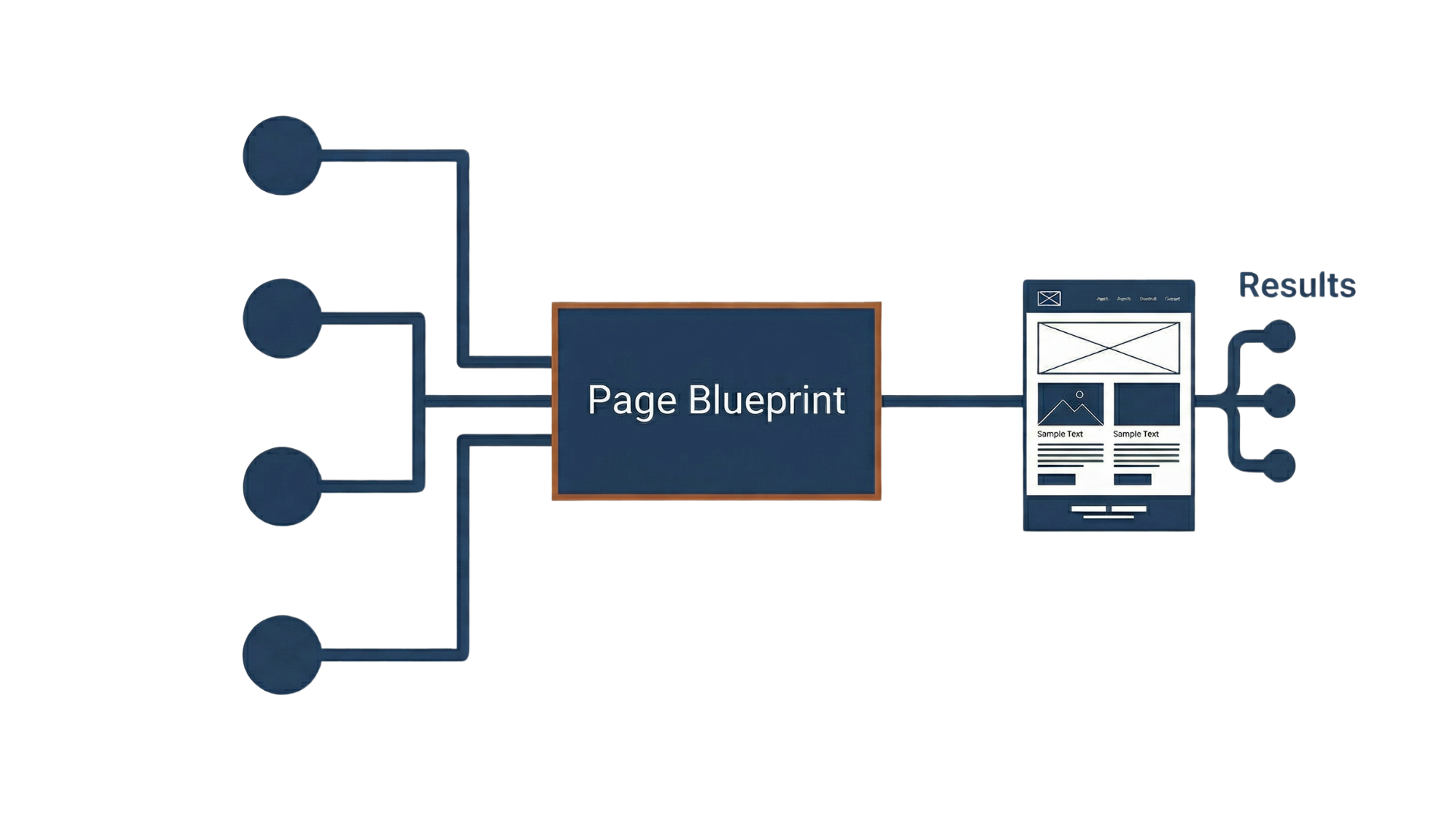
Most on-page SEO engagements end with a PDF report. The report lists what's wrong. The client forwards it to whoever writes the content, and the writer interprets the report. By the time the page is published, the document has been translated through two or three people who weren't on the audit call. The Blueprint replaces the report. It is the spec. The writer doesn't interpret it. They execute it.
The On-Page Optimization Blueprint is a page-by-page deliverable built before any execution begins. It contains:
- 01 Keyword map with intent notes for every page
- 02 Title and meta spec for every page
- 03 Content structure brief: what each page covers, in what order, to what depth
- 04 Internal link assignments: which pages link out, which receive links, and what anchor text
- 05 Schema deployment list: which schema types deploy on which pages
You use the Blueprint to brief your team, your developer, or your writer. Every decision is documented before a word is written.
The Blueprint is what separates page-level strategy from content writing. Content writing produces words. Page-level strategy decides which keyword the page targets, which intent it serves, how the H1 reads, what the title and meta say, where the page sits in the internal link map, and which schema deploys on it. Most agencies call all of that "writing." We call it the Blueprint, because the writing is the last step, not the first.
On-page optimization is the content layer of the Zero Page SEO™ system. The architecture is built first. The on-page work follows that spec.
This is where most on-page SEO work stops. Zero Page SEO™ is what builds the system underneath it.
If you want better-optimized pages, on-page SEO delivers that. If you want every page working as part of a system, that's what Zero Page SEO™ is for.
- Keyword architecture
- Cluster structure
- Internal link strategy
- On-page content layer
David Drewitz has audited and rebuilt on-page architecture for more than 12 service and local business sites, most of them with pages that had already been through SEO once. That shift comes from fixing the structure, not tweaking the elements.
About David →Frequently Asked Questions
Why Pages Don't Rank After Previous Optimization
Most pages that have been optimized and still aren't ranking were targeting the wrong keyword from the start. Changing the title tag doesn't fix that.
What does an on-page SEO company do?
An on-page SEO company is a firm that optimizes each page of your site to improve search rankings: title tags, meta descriptions, content structure, internal links, and schema. What separates a good on-page SEO company from the rest is where they start. The right keyword and the right intent, confirmed first, or optimization applied to a page that was built without that foundation. We start with the map.
How is on-page SEO different from technical SEO?
On-page SEO covers content structure, keyword mapping, and intent alignment. Technical SEO covers crawl architecture, canonicals, and site infrastructure. Both matter. They solve different problems.
Do you work on existing pages or only new builds?
Both. Existing pages get a full intent audit before any optimization. We confirm the page is targeting the right keyword and buyer before we change anything. New pages get the keyword map and content structure built before writing begins.
What do I receive at the end?
The On-Page Optimization Blueprint: keyword map with intent notes, title and meta spec for every page, content structure briefs, internal link assignments, and schema deployment list. A working document, not a report.
How long does on-page SEO take?
Depends on site size. Every engagement follows the same three stages: Map, Brief, Build. Initial audit and Blueprint (Map + Brief): 1 to 2 weeks. Build follows the Blueprint on an agreed schedule. See our process for how engagements are structured.
How does on-page SEO connect to your Zero Page SEO system?
On-page optimization is the content layer of the Zero Page SEO™ system. The architecture is built first, then the content is written to the spec. On-page SEO alone optimizes the content layer. Zero Page SEO™ builds the architecture underneath it.
Do you offer on-page SEO packages?
Scoped per engagement. Pricing depends on page count, how much rebuild or rework each page needs, and keyword complexity. Get a quote to scope your project.
Can on-page SEO fix pages that have already been optimized?
Yes, and that's most of what we do. Most pages we audit have been through an on-page optimization service before. The elements look right. The problem is the foundation: wrong keyword, wrong intent, wrong structure from the start. We fix the foundation. If your pages have been optimized and still aren't ranking, that's the exact situation this service is built for.
If your pages aren't ranking despite previous optimization, the architecture is the problem. We'll tell you exactly what needs to change.
Get a Quote →